Building better homes—not just more efficient ones.
The short answer
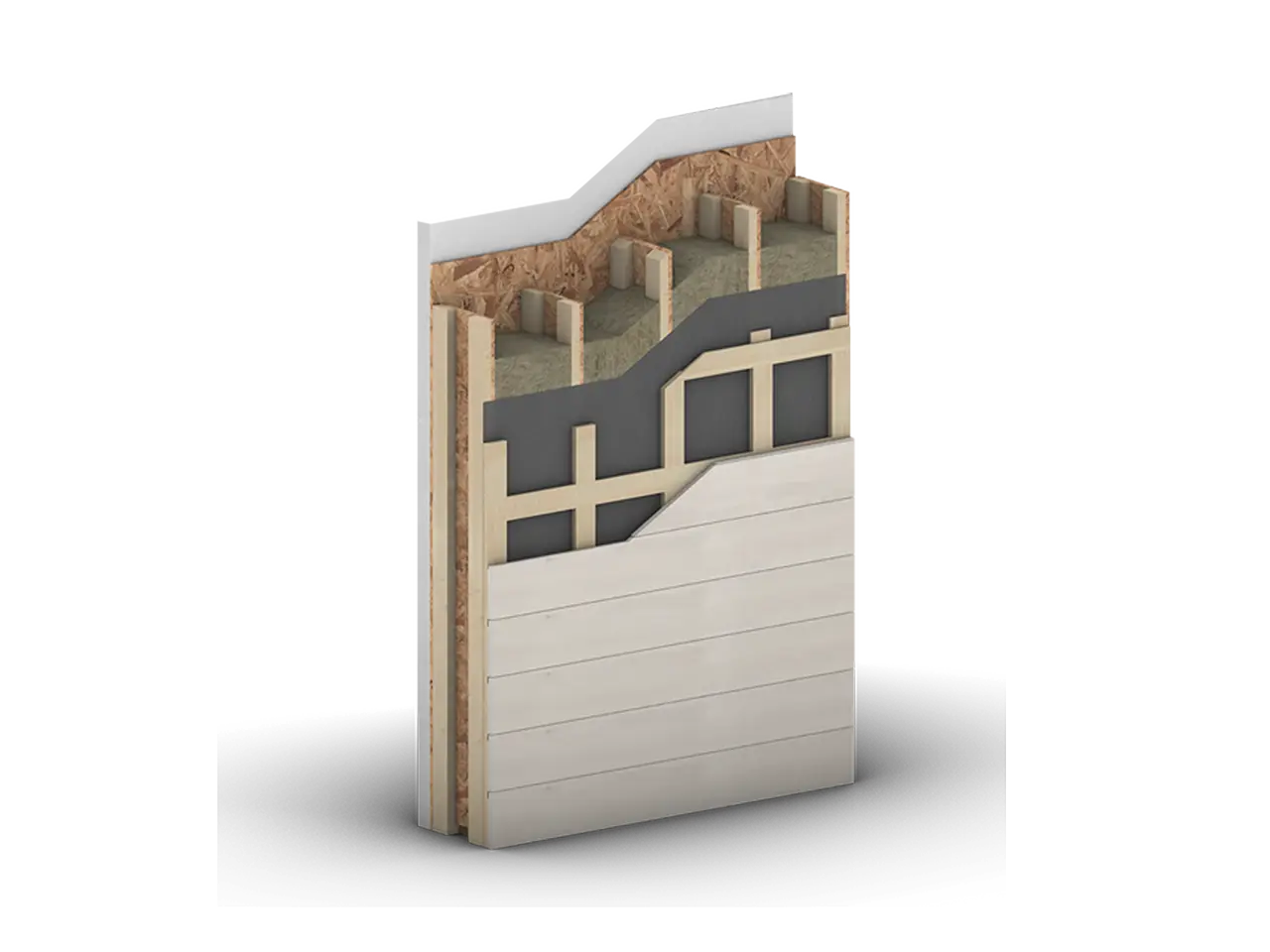
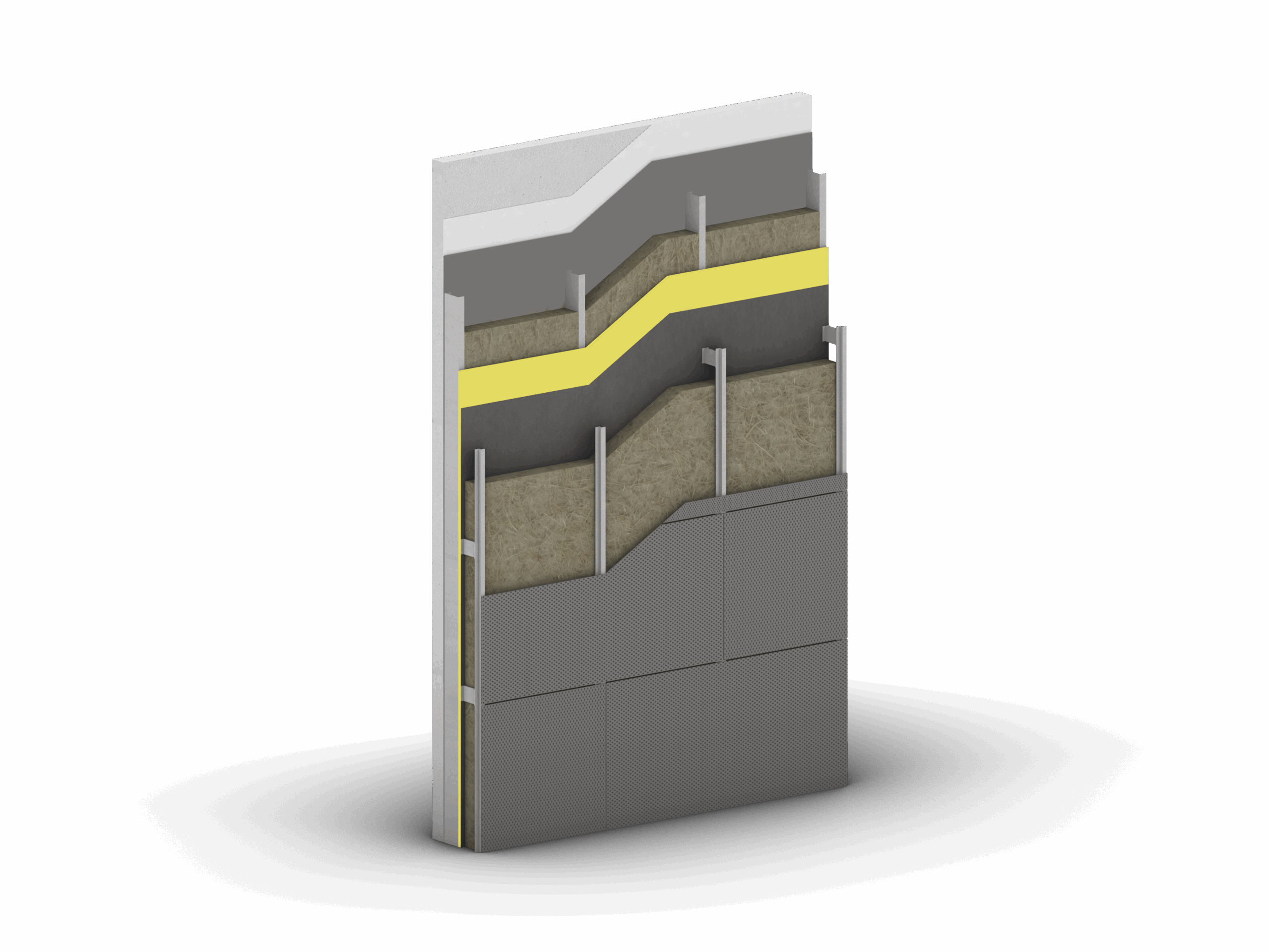
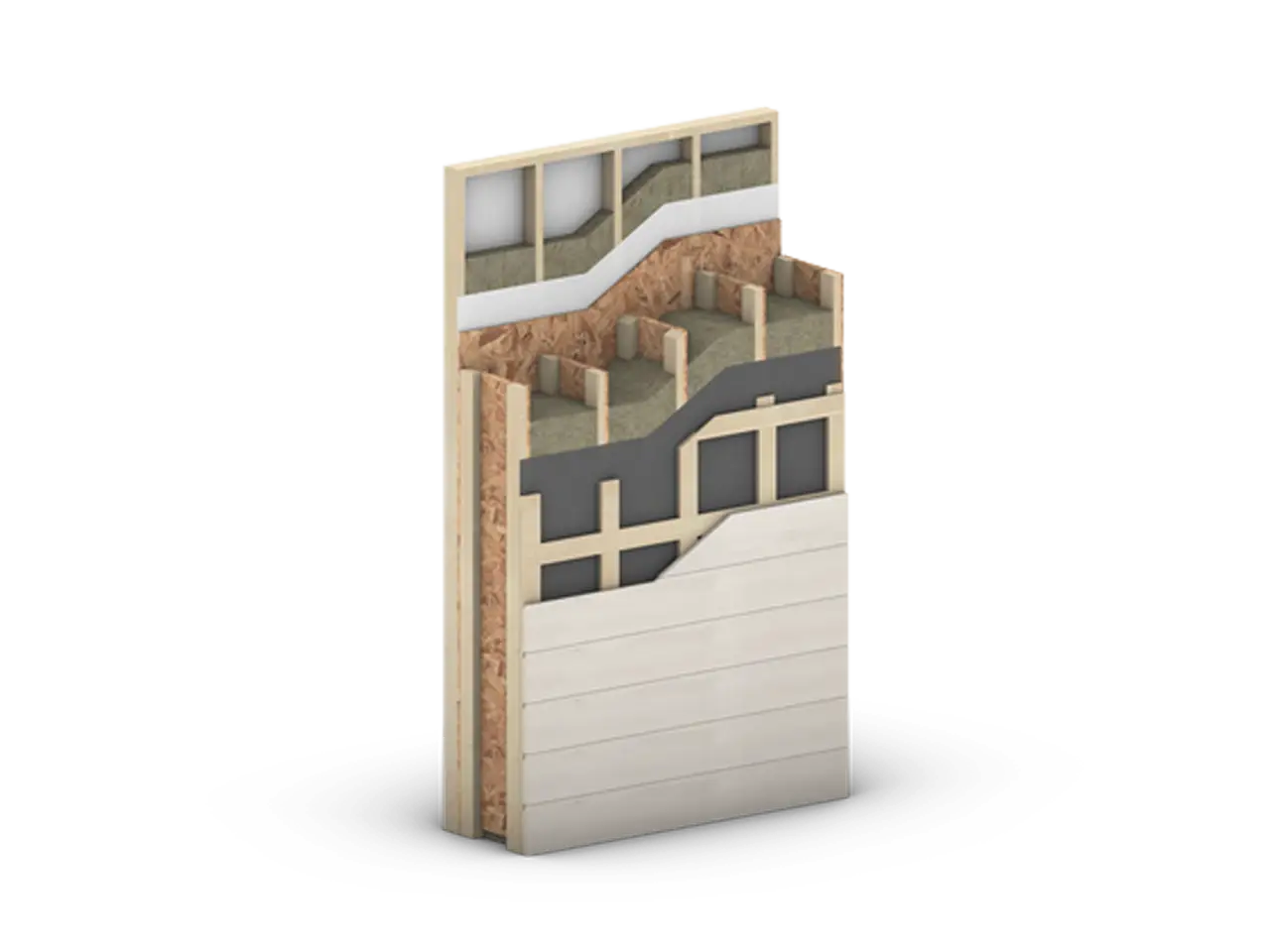
A Passive House is a world recognized building standard. It creates structures that are more comfortable, healthier, longer-lasting, and more energy efficient. It focuses on the parts of a home that matter most, including the walls, roof, windows, insulation, and air sealing.
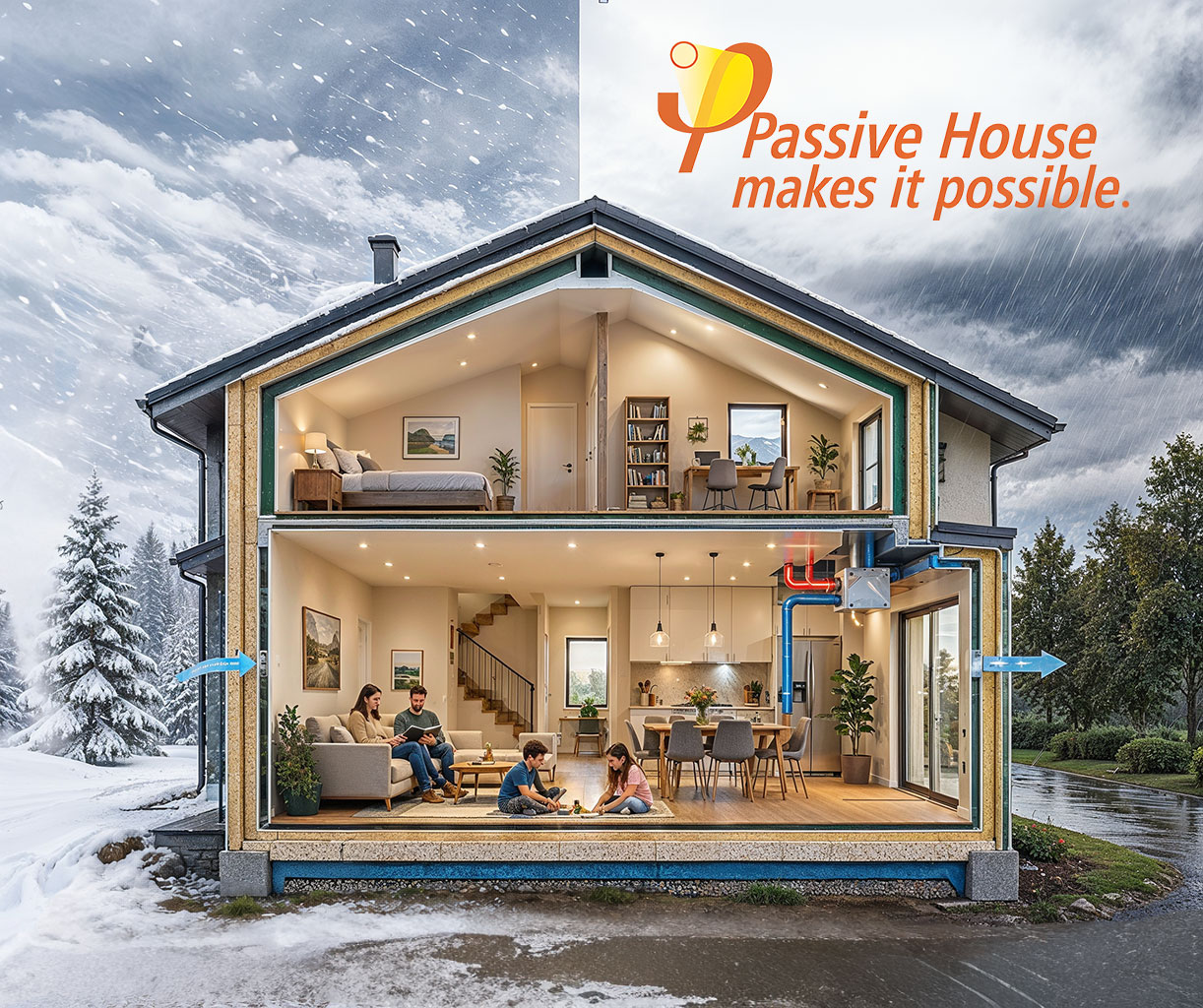
A Passive House keeps heat inside during winter and outside during summer. This helps keep the home comfortable all year while using up to 90% less energy for heating than a typical home.
Every Passive House is built around five key ideas. These include better insulation, fewer heat leaks, high-quality windows, airtight construction, fresh-air ventilation, and moisture control.
If you’ve heard the term Passive House, you might assume it just means a very energy-efficient home. Energy efficiency is part of the story—but it’s far from the whole point. Ask anyone who has lived in one and they’ll talk first about how it feels: warm walls, no drafts, quiet rooms, and air that’s always fresh.
This guide explains what a passive house really is, where the idea came from, how it works, what it costs, and whether it’s worth it—in plain English, no engineering degree required.
Passive House is about more than energy
The most important thing to understand is that Passive House is about more than saving energy. It’s about building better by controlling heat, air, and moisture. When you get those three things right, the benefits show up in every part of the home.
More Comfort
Even temperatures and fewer drafts in every room.
A longer-lasting home
Better moisture control helps protect the building.
More peace of mind
The home stays comfortable during heat waves, cold snaps, and poor air quality.
Cleaner air
A constant supply of fresh, filtered air.
Lower energy bills
Uses up to 90% less energy for heating.
Peace and quiet
Thicker walls and better windows help block outside noise, creating a quieter home with a deep sense of peace.
The origins of Passive House
The modern Passive House standard began in Germany in the early 1990s, but its ideas are not new.
For thousands of years, builders have known a key truth: the best buildings work with nature.
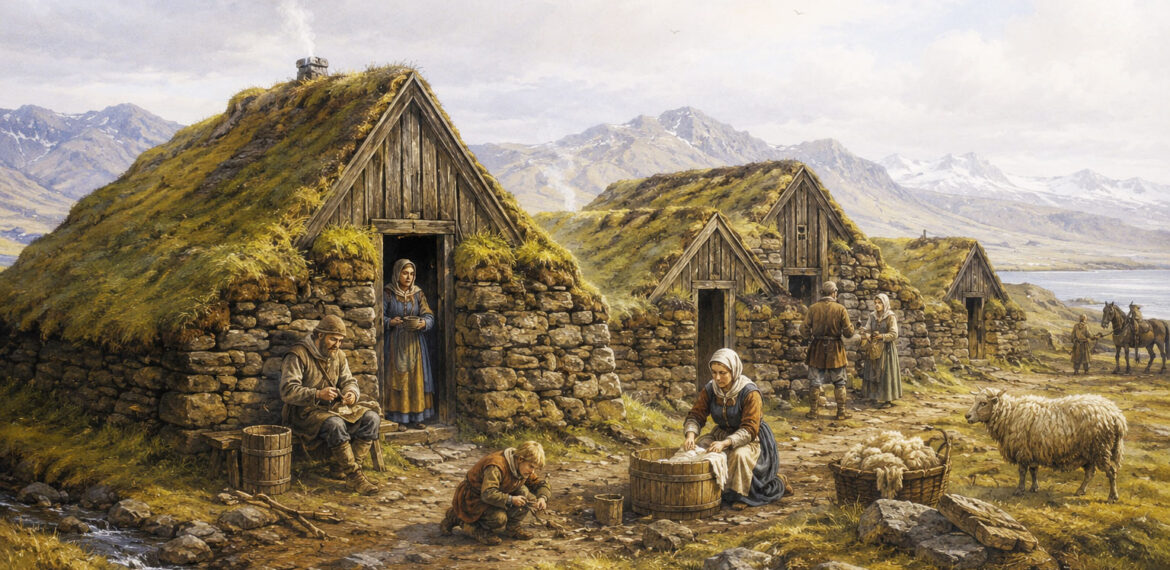
Traditional Icelandic Turf Houses – Early Inspiration for Passive House Design
Ancient Greeks designed their homes to capture the low winter sun for free heat while shading against the summer heat. In Iceland, thick turf houses used earth as natural insulation to keep families warm in harsh winters.
The famous Norwegian polar exploration ship Fram, built in the late 1800s, had advanced features for its time. It included thick insulation, triple-pane windows, and controlled ventilation. The ship’s design was so efficient that the crew often relied only on cooking heat to stay comfortable in the Arctic.
The Fram: An Early Example of Passive House Thinking
These builders lacked modern tools and materials. They grasped important building principles: capture free heat from the sun, keep it, shield against the elements, and ensure durability.
Modern Passive House blends years of building science, smart materials, precise engineering, and strict quality control. It transforms centuries of knowledge into a clear and repeatable performance standard.
The Canadian Passive House Connection
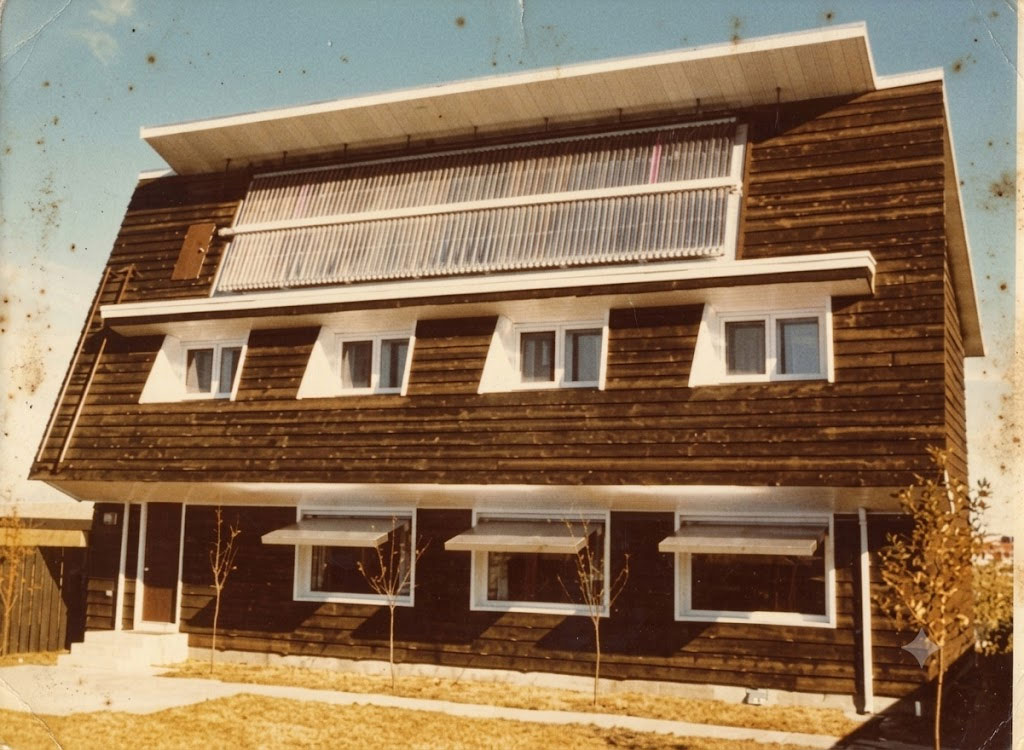
In 1977, builders constructed the Saskatchewan Conservation House in Regina, Canada. This marked a big step in modern high-performance building. Built during the 1970s energy crisis, this design includes key Passive House principles. It provides great insulation and strong airtightness. It also features heat recovery ventilation and a smart building envelope design.
Saskatchewan Conservation House – Early Passive House Building in Canada
Almost 50 years later, the building still performs great. This shows that these ideas aren’t just theories; they’re proven practices. A well-designed building envelope controls heat, air, and moisture. This is key to its long-term success. This design can keep its performance strong for decades.
The project taught us a key lesson about Passive House. True energy efficiency doesn’t come from a bigger furnace. It comes from creating a better building envelope. And when buildings stay dry, they last. Moisture—not age—is the leading cause of building failure.
The Birth of the Passive House Standard
Inspired by decades of research and projects like the Saskatchewan Conservation House, Swedish researcher Bo Adamson and German physicist Dr. Wolfgang Feist began developing a new building standard in the late 1980s.
Their goal was not just to build energy-efficient homes. They wanted to set a clear standard. This standard ensures comfort. It also promotes healthy indoor air. Plus, it offers great energy performance in any climate.
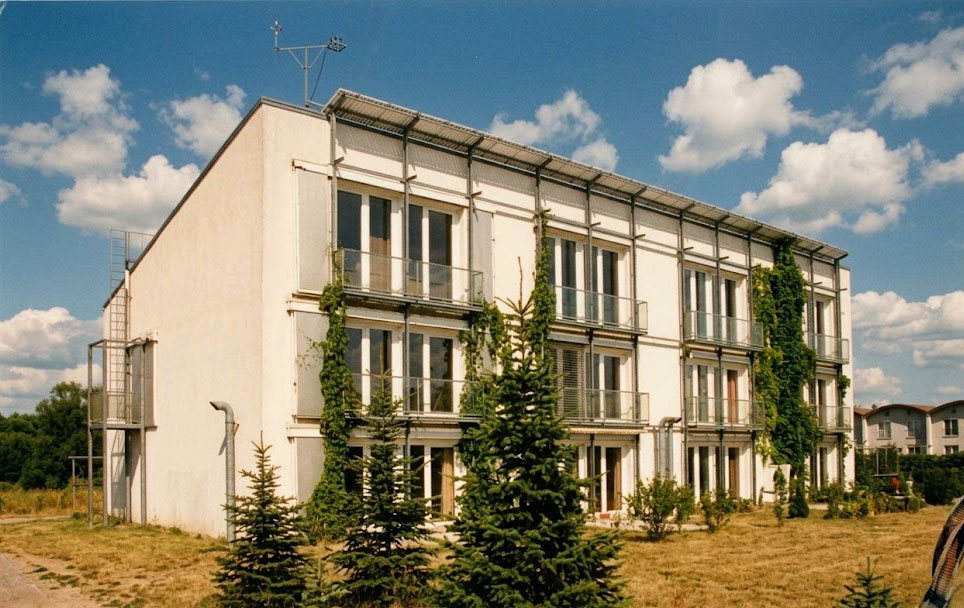
In 1991, the first certified Passive House was finished in Darmstadt, Germany. This made the vision a reality. Over 30 years later, the building still meets its original design goals. This shows that Passive House is not just an experiment; it’s a tested building standard.
Darmstadt Passive House – The First Certified Passive House
Today, there are thousands of certified Passive House buildings worldwide. They include homes, schools, offices, hospitals, apartment buildings, and even skyscrapers. Construction methods change. The basics stay the same. First, build a strong envelope. Then, let physics take over.
How Does a Passive House Work?
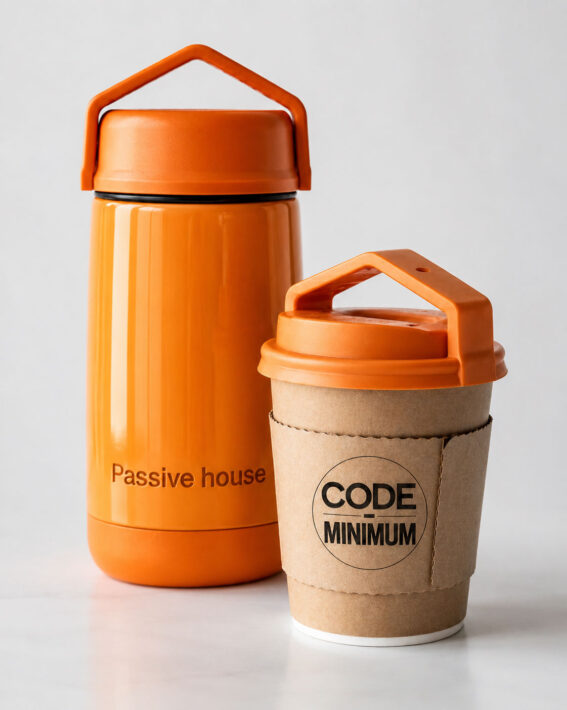
Think of a Passive House like a high-quality thermos. Seal it tightly. It stays hot or cold for hours. It uses very little outside energy. A Passive House works the same way. Its smart building design keeps heat where you want it. In winter, it stays inside. In summer, it stays outside.
A Passive House relies on physics. It doesn’t fight the weather with large furnaces or air conditioners. The building loses less heat, so it needs very little energy to stay comfortable inside.
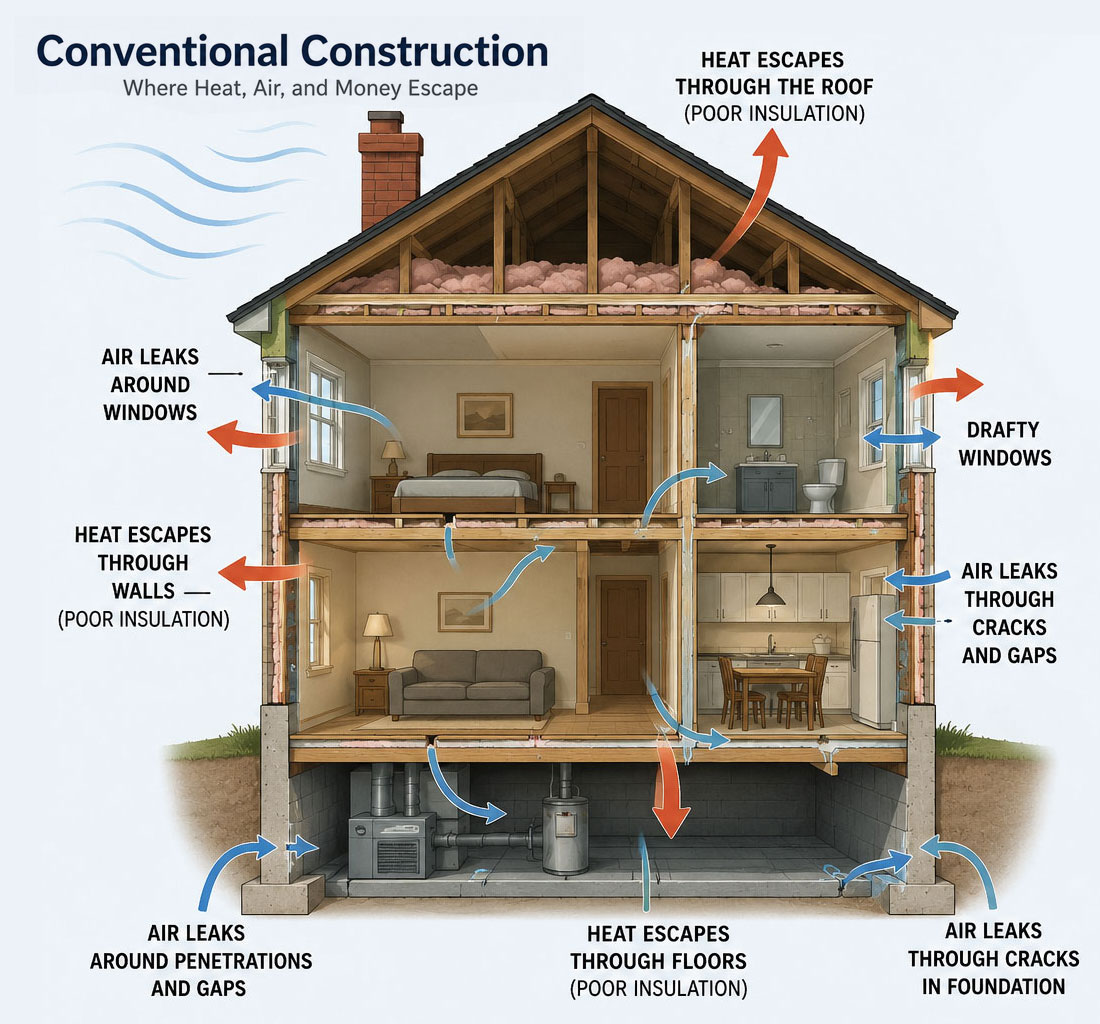
In a typical home, heat often escapes quickly. This occurs because of leaky walls, drafty windows, and roofs with poor insulation. Uncontrolled air leaks make it worse.
Heat escapes through the roof, walls, windows, and hidden air leaks in a typical home.
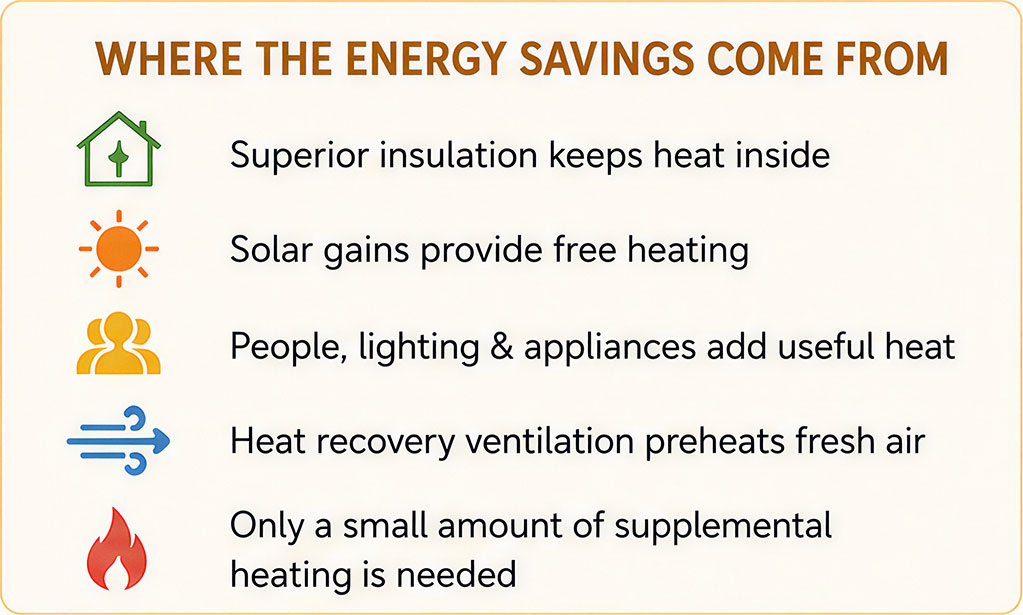
Each day, a home gets “free” heat. This comes from the sun shining through the windows. It also comes from people inside who are cooking, using lights, and running appliances.
A Passive House stands out because it loses very little heat. Everyday heat sources play a big role in keeping the home warm. The building keeps the energy it already has instead of using a big heating system to replace what’s lost.
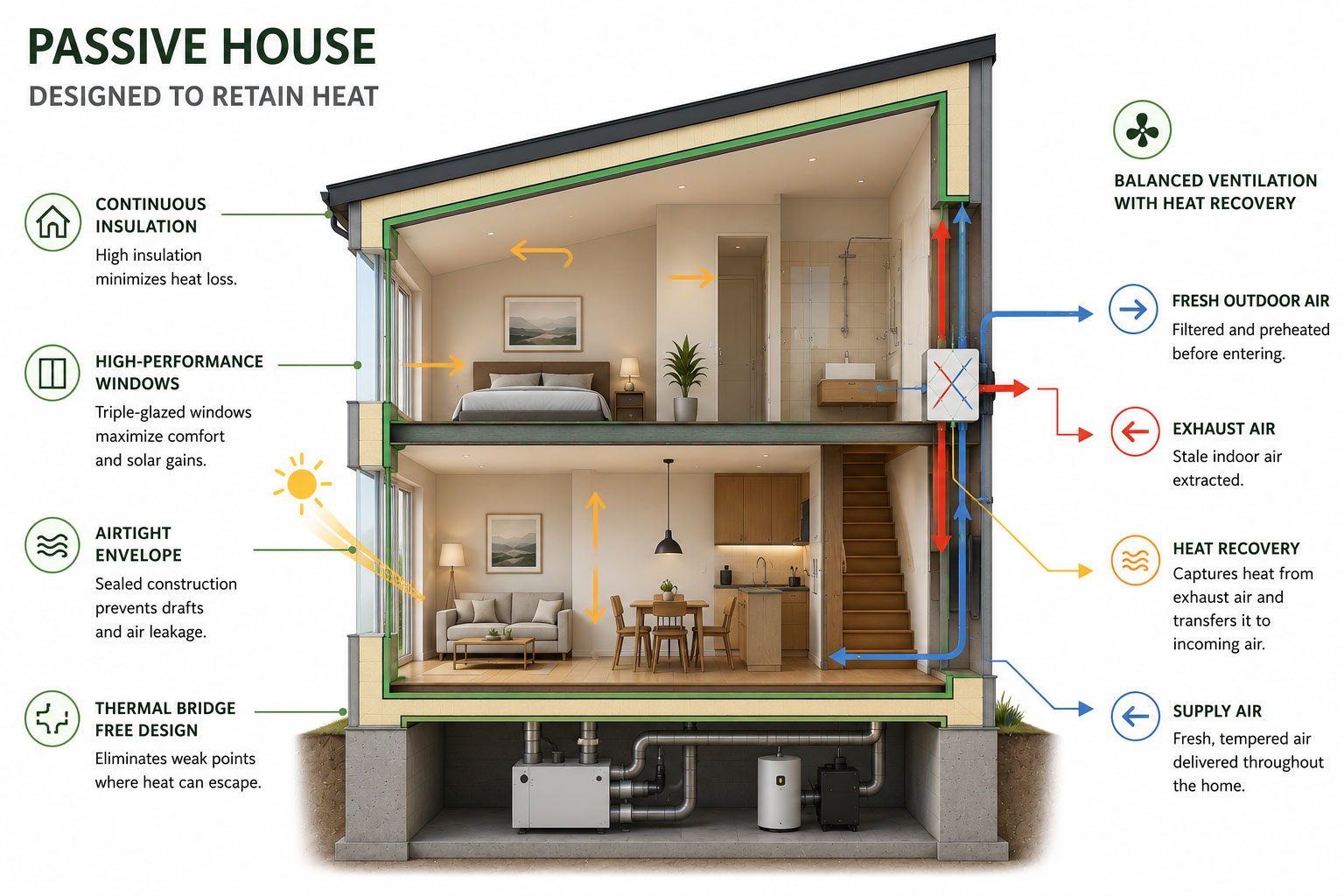
Fresh air comes in easily with a heat recovery ventilation (HRV) or energy recovery ventilation (ERV) system. When stale air exits the home, it transfers heat to the fresh air coming in. This keeps indoor air quality high and reduces energy loss.
The result is a home that stays remarkably consistent throughout the year. Temperatures stay steady in every room. Interior surfaces feel warm in winter. Drafts are nearly gone, and the building uses much less energy than a regular home.
The secret isn’t a complicated mechanical system or futuristic technology. Its smart design manages heat, air, and moisture. This lets physics handle much of the work.
A thermos keeps your coffee warm for hours. A paper coffee cup loses its heat in an hour. That's the difference between a Passive House and a code-minimum home.
The five principles of Passive House
Every certified passive house is built around the same five core principles.
Continuous insulation
Passive House buildings use significantly more insulation than conventional construction. The goal isn’t simply thicker walls—it’s reducing heat flow so the building holds a stable indoor temperature all year.
Thermal bridge-free design
Heat always follows the path of least resistance. Thermal bridges are weak spots in the building envelope. They occur when building parts break the insulation barrier.
This Includes:
Wall studs
Structural steel
Balcony connections
Concrete slab edges
Fasteners
Holes
Passive House design minimizes these weak points to improve comfort, efficiency, and durability.
High-performance windows
Passive House windows usually have triple-pane glazing. They also include well-insulated frames and warm-edge spacers. Careful installation is key, too. These windows stay warm in winter. They cut down on drafts, condensation, and cold spots by the glass.
Airtight construction
A passive house is carefully sealed to prevent uncontrolled air leakage. This means no cold drafts. You'll have less heat loss, better moisture control, and improved indoor air quality. Rather than relying on random cracks in the envelope, fresh air enters the home in a controlled way.
Balanced Ventilation with Heat Recovery
Passive houses are very airtight. So, they use a mechanical ventilation system (MVHR) to supply fresh air. These systems provide fresh, filtered air and remove stale air. They recover heat from outgoing air and lower energy use. This creates a healthier indoor space with steady fresh air and great comfort.
Every part of a Passive House works together to keep heat in, fresh air flowing, and energy use low.
How much energy does a passive house save?
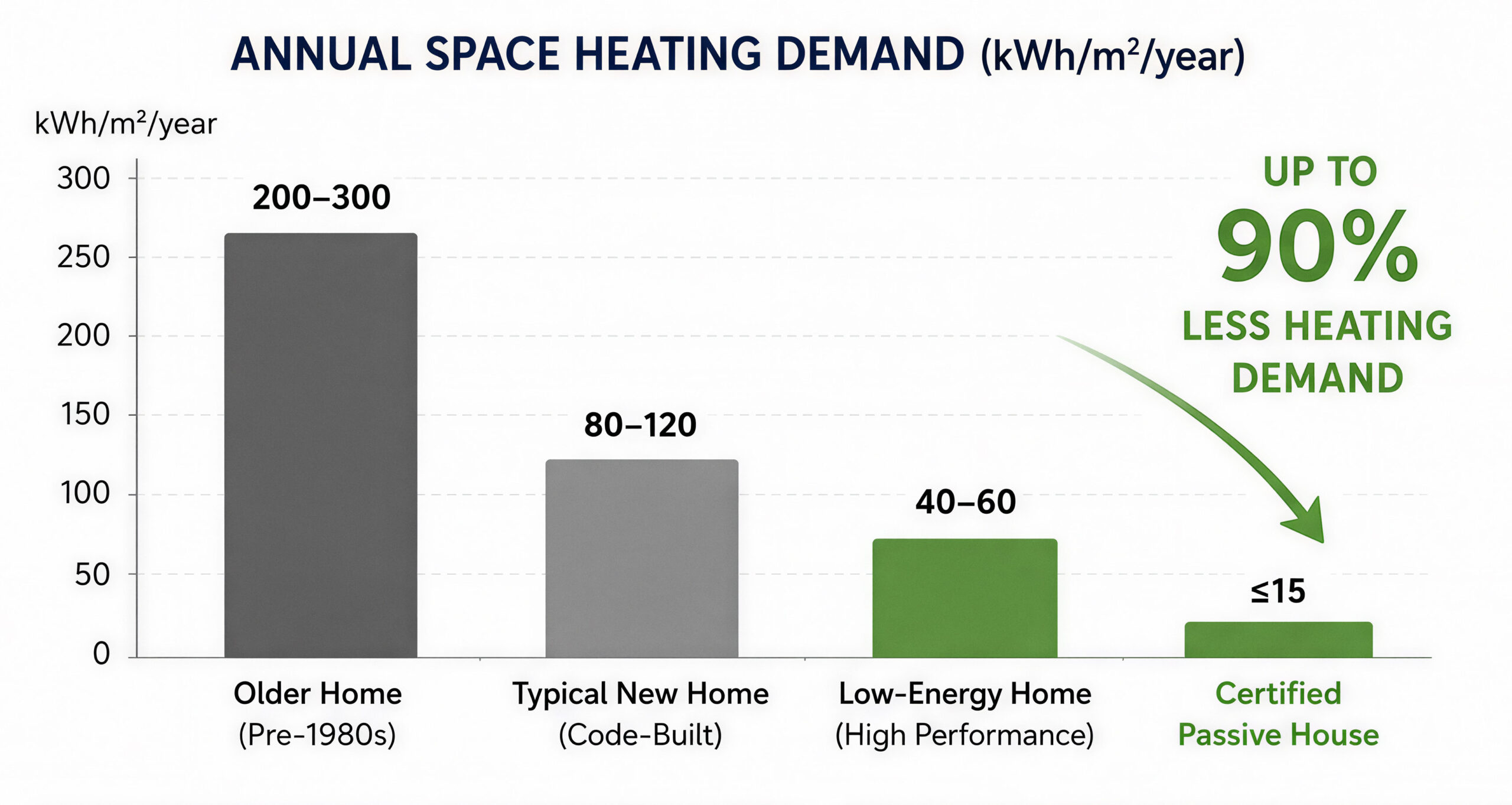
While Passive House is about much more than energy, the performance is striking. A certified passive house lowers space heating needs by around 90%. This is much less than regular buildings.
A certified Passive House requires about 90% less space-heating energy than a conventional home.
Built to a Measurable Standard
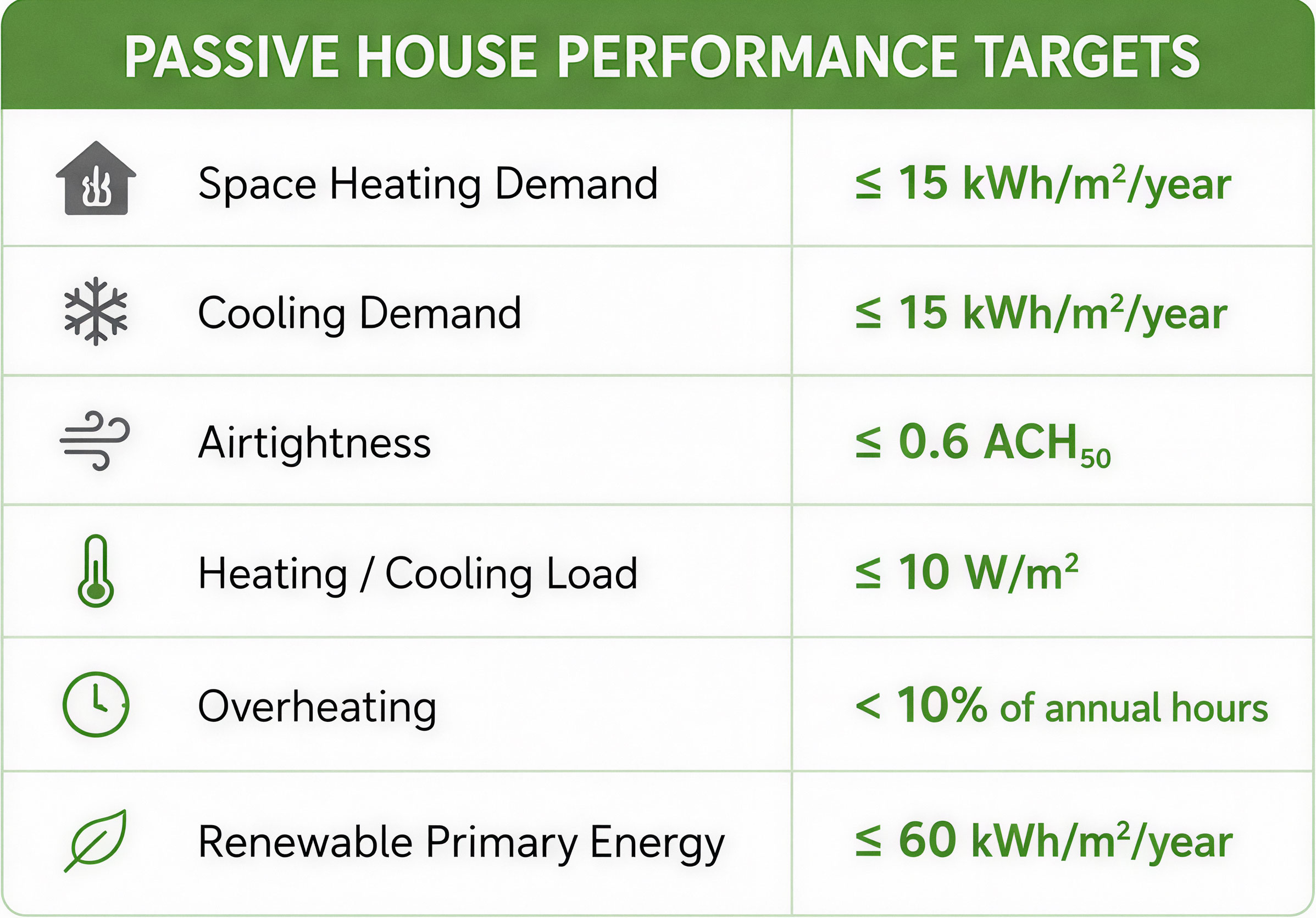
Passive House isn’t based on opinions or marketing claims. Every certified building must hit strict performance targets. Energy modeling and testing check these.
These targets make sure every Passive House offers comfort, energy efficiency, and durability.
Certified Passive House buildings must meet strict performance targets for energy efficiency, airtightness, comfort, and indoor climate.
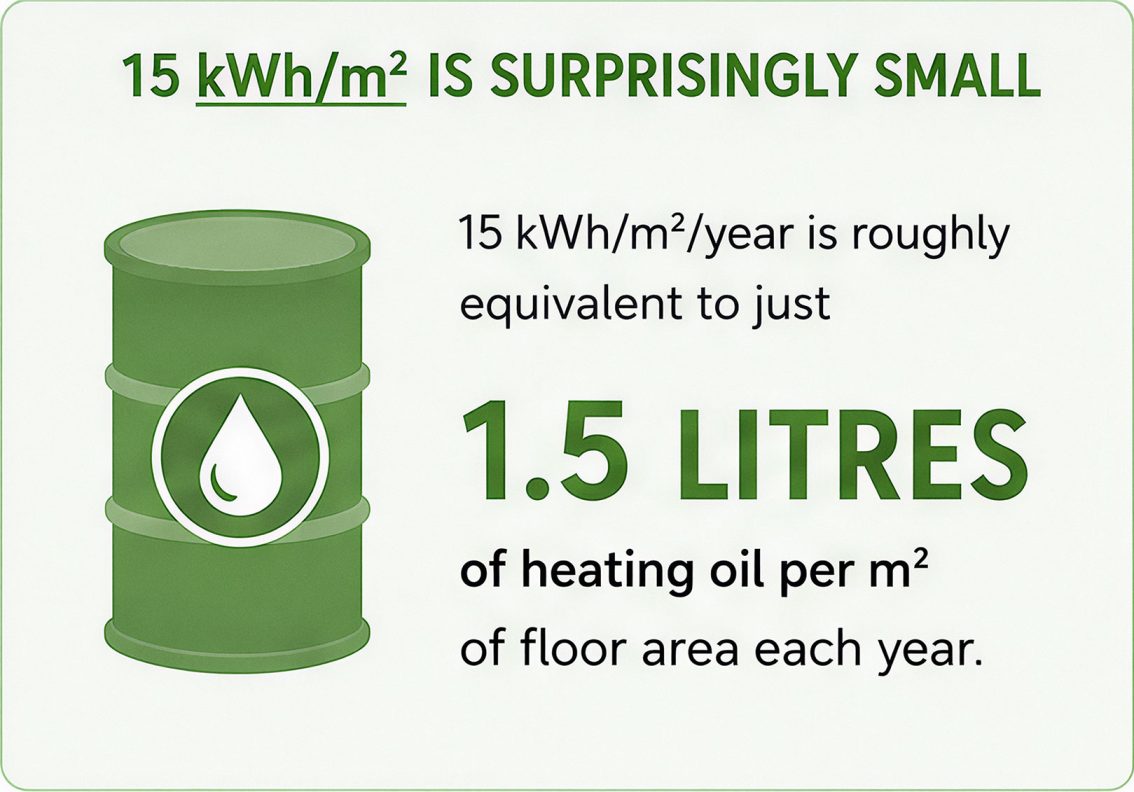
15 kWh Is Smaller Than You Think
The target of 15 kWh/m²/year sounds technical, but here’s an easier way to picture it.
It is roughly equal to just 1.5 litres of heating oil per square metre each year.
That tiny amount of energy is all a Certified Passive House needs to stay comfortable through winter because so little heat is allowed to escape.
A Certified Passive House needs remarkably little energy to stay warm—just 15 kWh/m²/year, or about 1.5 litres of heating oil per square metre annually.
Where Does the Energy Go?
Most homes stay warm by producing more heat.
A Passive House takes a completely different approach—it needs much less heat in the first place.
Instead of constantly replacing lost heat, the building keeps warmth inside and makes better use of heat that already exists.
Passive House saves energy by reducing heat loss and making the most of free and recycled heat sources.
A Real-World Example
The savings become even more impressive when you look at an entire home.
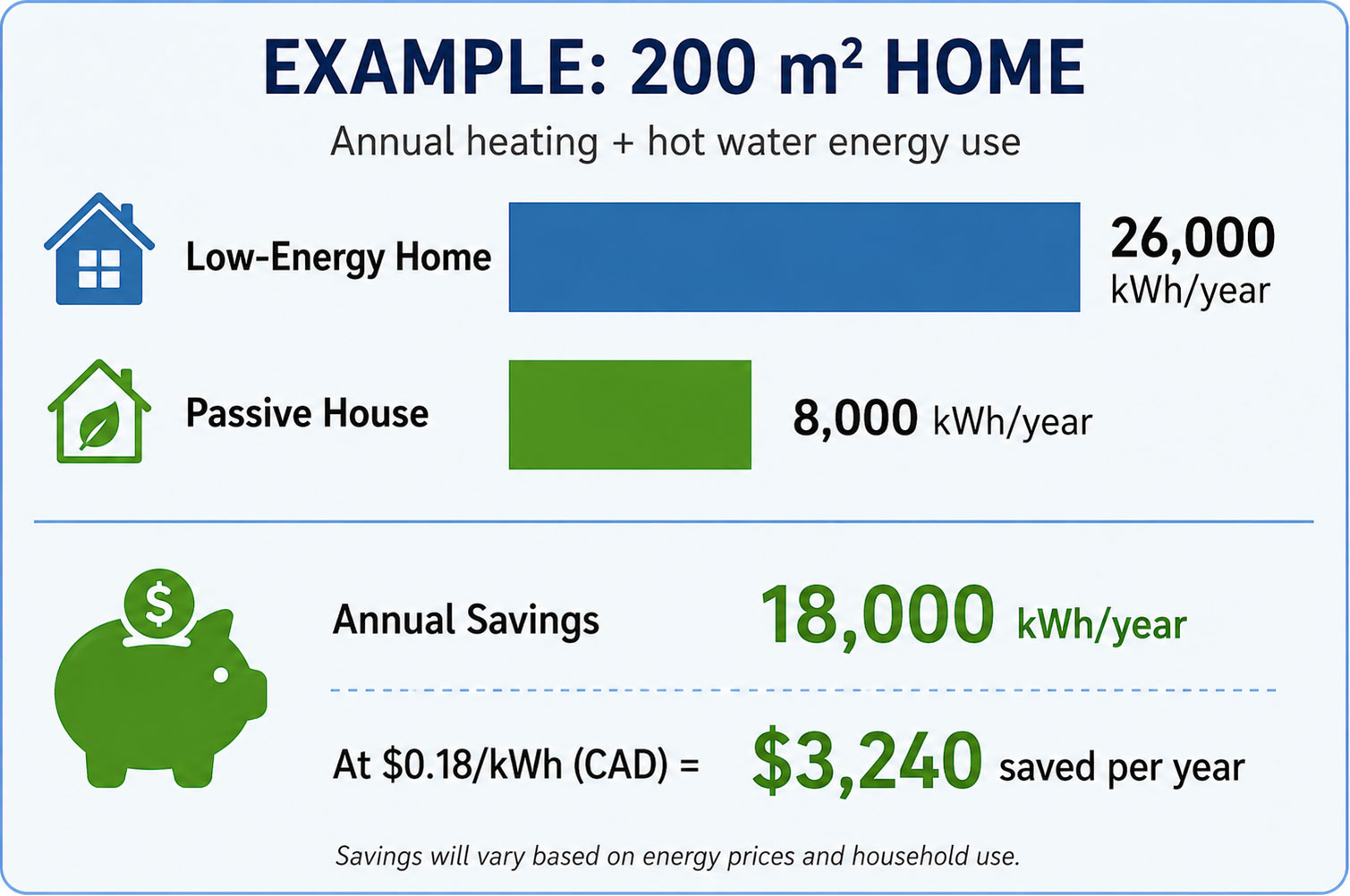
For a 200 m² (2,150 sq. ft.) house, the course compared a Low-Energy Home with a Certified Passive House.
For a 200 m² home, Passive House can reduce annual heating and hot water energy use by approximately 18,000 kWh compared to a typical low-energy home.
The Low-Energy Home requires approximately 26,000 kWh of heating and hot water each year.
The Passive House requires only 8,000 kWh.
That’s an annual reduction of 18,000 kWh—a difference that can translate into thousands of dollars in energy savings over the life of the home, depending on local energy prices.
Durability Starts with Moisture Control
One of the best perks of Passive House isn’t obvious on moving day; it’s what doesn’t happen over the next 50 to 100 years.
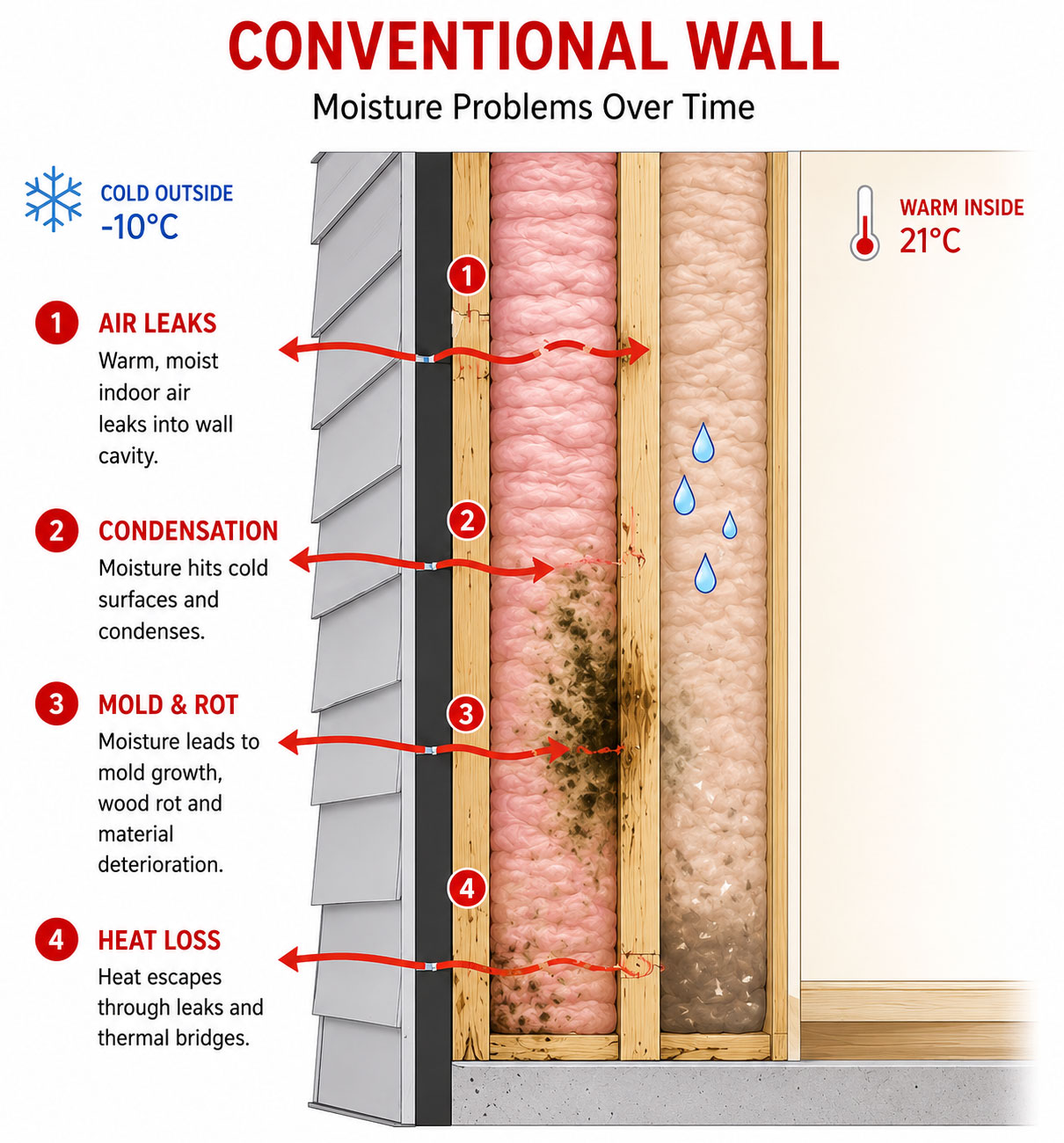
Traditional buildings often allow warm, moisture-laden air to leak into walls and roofs. When that air reaches a cold surface, it condenses into liquid water. Over time, hidden moisture can cause mold, wood rot, corrosion, and damaged insulation. This can lead to costly structural repairs.
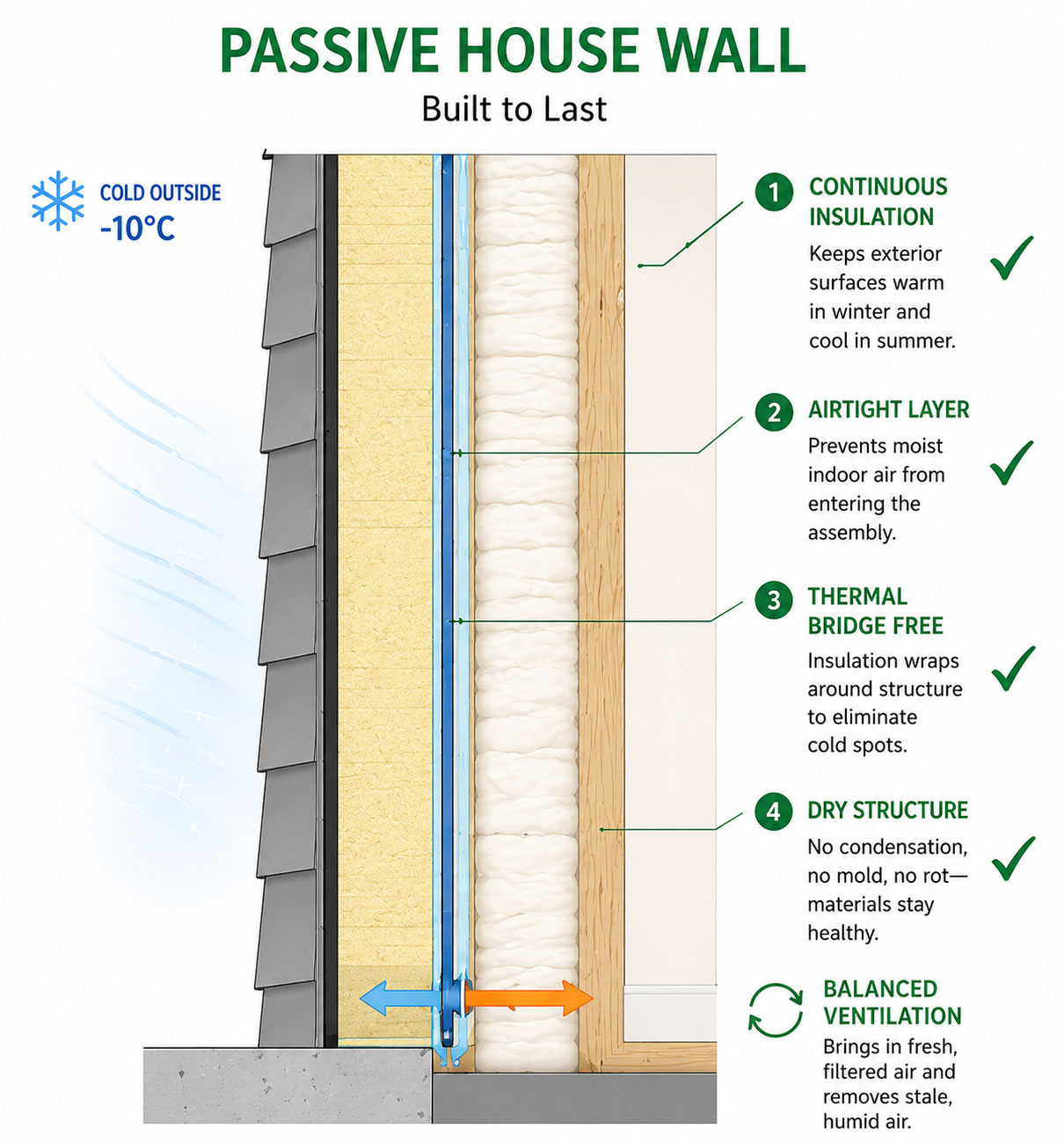
Passive House is designed to prevent these problems before they begin.
By combining:
Continuous insulation to keep building surfaces warm
An airtight building envelope that prevents moist indoor air from entering the assembly
Thermal-bridge-free detailing that eliminates cold spots
Balanced ventilation that manages indoor humidity
…the building remains dry, stable, and healthy throughout the year.
The result is a structure that performs well, protects its materials, and lasts longer. It also has fewer moisture-related issues. In many ways, Passive House is as much a durability standard as it is an energy standard. The first Passive House, built in 1991, still works as planned today. This shows how durable the standard is over time.
Passive House vs. Net Zero
These terms are often confused, but they describe two different things.
Passive House is a building standard. It reduces energy use by building an exceptionally well-insulated, airtight home that keeps heat where it belongs and brings in fresh air efficiently.
Net Zero is an energy goal. A Net Zero home produces as much renewable energy—usually with solar panels—as it uses over a year.
The two work exceptionally well together. Because a Passive House uses much less energy for heating and cooling, it needs a much smaller solar system to achieve Net Zero.
Think of it this way: Passive House reduces the amount of energy a home needs. Net Zero produces the energy it still uses.
How Much Does a Passive House Cost?
There is no single answer.
The cost to build a Passive House varies. It depends on the size, design, climate, materials, and the expertise of the team. Most projects have a small upfront cost compared to traditional construction. However, this cost can differ from one project to another.
The important question isn’t “How much more does it cost?”
It’s “Where is the money being spent?”
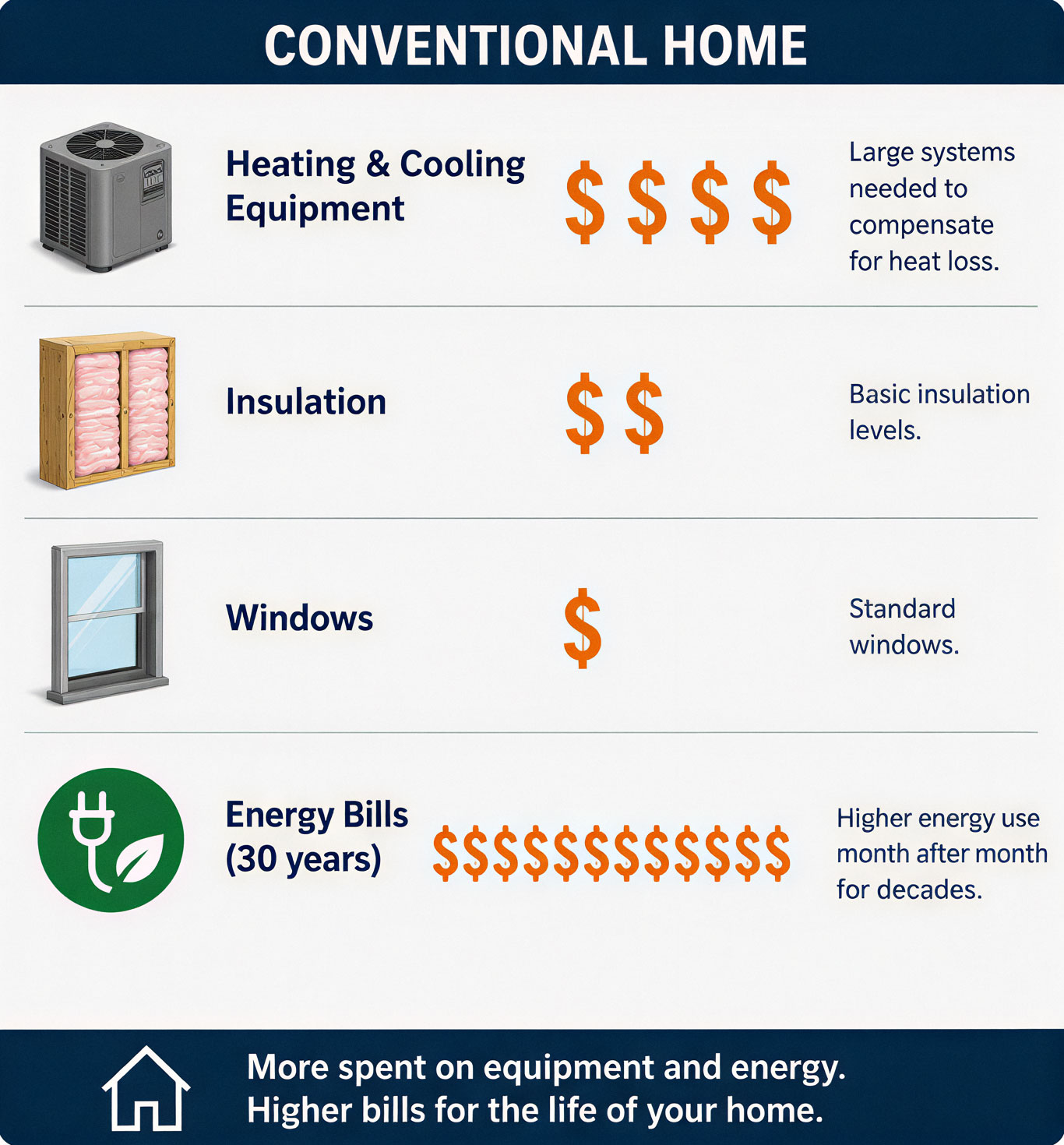
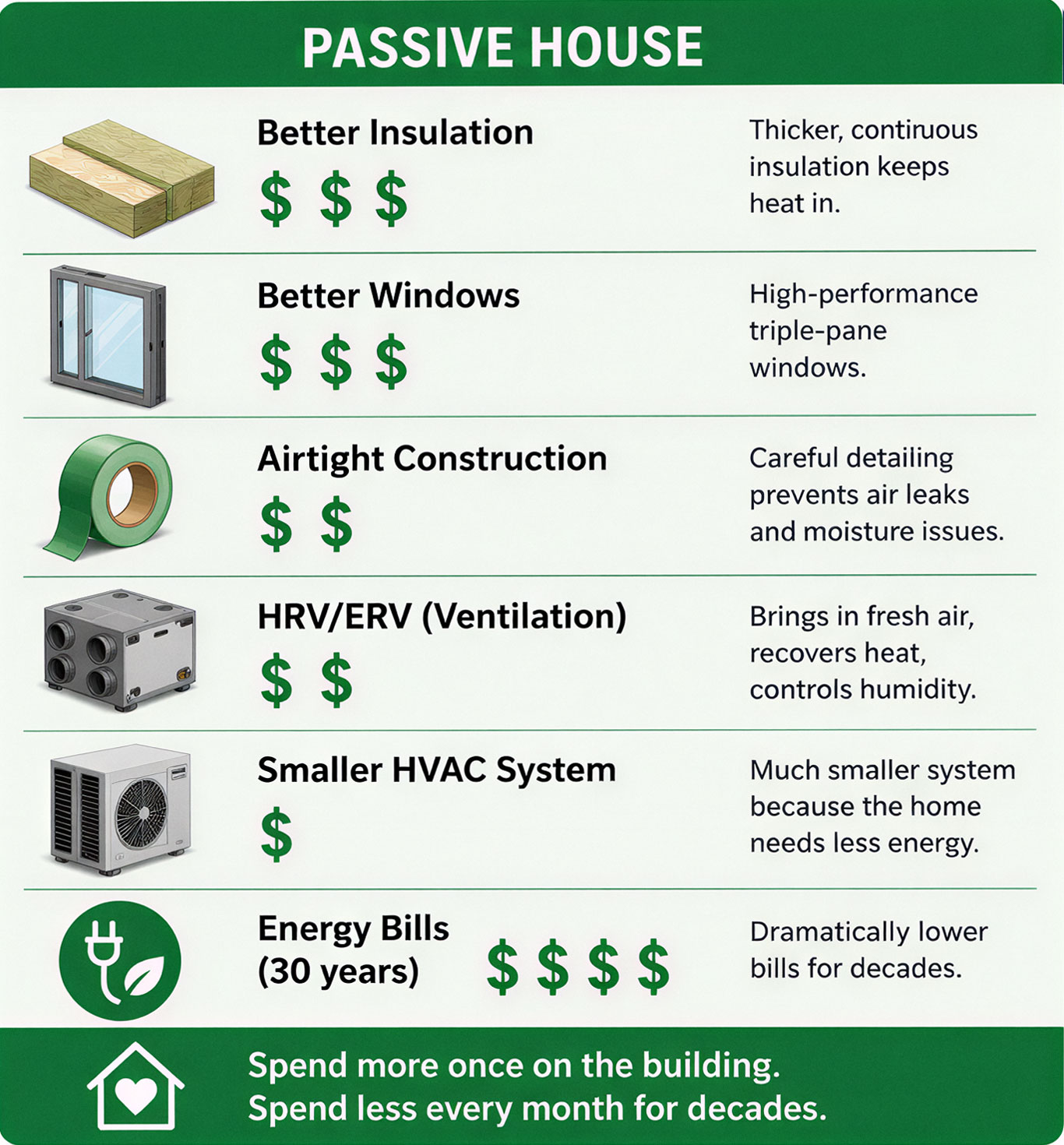
Passive House emphasizes a strong building envelope. This method cuts down on the need for big furnaces and air conditioners to manage heat loss.
Where is the money being spent?
A Passive House costs more to build because you’re investing in parts of the home that never wear out.
Insulation doesn’t need replacing.
Airtight construction doesn’t become obsolete.
Well-designed wall assemblies continue performing for generations.
Instead of paying higher utility bills every month, you’re investing upfront in a home that is quieter, healthier, more comfortable, and less expensive to operate.
Is a Passive House Worth It?
For many homeowners, the answer is yes.
A Passive House offers benefits that extend well beyond lower energy bills:
Benefits:
Up to 90% lower space-heating demand
Consistent temperatures throughout the home
Continuous filtered fresh air
Exceptional indoor comfort
Very quiet interiors
Better moisture control and long-term durability
Lower operating costs
Greater resilience as energy prices rise
Higher equity and resale value over time
Considerations:
Higher upfront construction costs
Ventilation filters need periodic replacement
Good planning and detailing are essential
Passive House Is a Standard, Not a Product
Passive House is not a product. It’s a performance standard.
It isn’t a special wall system, a particular brand of insulation, or a specific type of window. A Passive House can be built using many different construction methods and materials.
What makes it a Passive House is the result.
To get certified, each building must meet clear targets. These targets include energy efficiency, airtightness, thermal comfort, indoor air quality, and durability. These targets use energy models. They also rely on real performance tests, not just marketing claims.
A Passive House keeps your family comfortable, healthy, and protected in every season.
Passive House is not a product. It’s a performance standard.
It isn’t a special wall system, a particular brand of insulation, or a specific type of window. A Passive House can be built using many different construction methods and materials.
What makes it a Passive House is the result.
To get certified, each building must meet clear targets. These targets include energy efficiency, airtightness, thermal comfort, indoor air quality, and durability. These targets use energy models. They also rely on real performance tests, not just marketing claims.
The Bottom Line
Passive House represents a different way of thinking about construction.
Passive House focuses on the building envelope. It avoids heat loss instead of just using bigger heating and cooling systems. Managing heat, air, and moisture keeps your home comfortable, healthy, and efficient year-round.
The result is a home that is:
More comfortable
Healthier to live in
Quieter
More durable
More resilient
Far more energy efficient
Less expensive to operate over its lifetime
Passive House has over 30 years of success. It is now a trusted standard for high-performance buildings around the world.
Because in the end, Passive House isn’t really about saving energy.
It’s about building better homes for the people who live in them.
Eddie is the Head of Marketing at Quantum Passivhaus and a Certified Passive House Tradesperson (CPHT). Combining expertise in high-performance building science with strategic marketing, Eddie is passionate about making Passive House concepts easy to understand for homeowners, builders, and industry professionals.